Body was composed of plant cells. The cells will be assembled to form a network, the network will come together to form organs andso on up to form one plant.

Here are discussed the various tissues and organs that make up the plant body.
Plant tissues can be divided into two kinds:
A. Meristem tissue / young
2. Adult tissues
Meristem tissue
Meristem network is a network that continually divide and tissues is relatively young, full of cytoplasm, has the ability totipotensi high because of the ability to form other tissues of adult tissues.
Meristem tissues can be divided into two kinds
A. Primary Meristem tissue
This meristem tissue in plants in the youngest parts of the organ.
is a further development of the embryonic growth / bud / institution
have the ability to divide, elongate and form berdefrensiasi and specialist in adult tissues.
These networks tend to produce the hormone auxin to make the division of continuous longitudinal direction.
This network lies at the end of the stem, root tip, later known as the apical meristem apical dominance leading je
Primary meristem tissue growth is often called primary growth.
primary meristem tissue bertambang cause stem and root length was not dilated. OK
2. Secondary Meristem tissue
Network of secondary meristem is meristem tissue from the primary meristem tissues that do defrensiasi and specialization
an adult tissue, but has the ability totipotensi again
These networks are in the middle of the organ to the formation of different tissues from the previous
Secondary meristem tissue growth is called secondary growth.
Enlarged towards its growth, giving rise to substantial increase of a plant.
Examples of the secondary meristem cambium tissue.
Cambium
cambium is the layer of plant cells which are the adult tissues such as (epidermis, parenchyma, kolenkim, sklerenkim) cells but cells have the ability totipotensi
because it can mersifat cambium meristem meristem again resulting in the formation of the two is then called secondary meristem tissues.
Cambium activity which is a secondary meristem tissues are continuously divide, enlarges and berdefrensiasi xylem and phloem form a network carrier.
splitting out the form Phloem (filter vessel tissue / skin) and split into the form xylem (wood vessels) so that the shadow of growing plants
formation of xylem / Phloem transport processes of substances intended for
The xylem vessels for transport facilities and mineral water are the means Phloem vessels for transportation of Photosynthesis
Keep in mind the formation of xylem and the cambium Phloem is determined by environmental factors such as water and minerals, then the cambium form X / F in the rainy and dry seasons also must be different then formed a circle in
drought X / F is only formed because of the difficulty of getting the water line so that pembelahannya being hampered in the rainy season needs are met then the formation of X / F be a more rapid cell division as a result becomes thicker, a matter of course by looking at the line trunk line that can be measured age OK
Cambium activity causes secondary growth, so that the stems of plants to be great. It occurs in plants dikotil and Gymnosperms (seed plants open).
During growth, growth in the cambium towards more active than the cambium growth outward, causing the bark is thinner than the wood.
Based on the ability of the formation of a cambium tissue vascular cambium daibagi (intravascular): cambium contained in the beam transport (phloem and xylem in between). Function: to the outside forming secondary phloem form a fan in the direction of the secondary xylem.
Cambium intervaskuler: cambium located between two file transport / out of beam transport.
Function: to form the radius pith.
Based on its location meristem tissue is divided into three, namely the apical meristem, meristem interkalar and lateral meristem.
Apical meristem is meristem located in the root tip and at the end of the rod. Always result in the apical meristem cells to grow memanjang.Pertumbuhan elongated due to the activity of the apical meristem is called primary growth. Network formed from the apical meristem are called primary tissues.
Interkalar meristem or meristem between the meristem is located between the primary meristem tissues and adult tissues.Examples of plants that have the stem meristem interkalar grasses (Graminae). Interkalar meristem cell growth led to more rapid stem elongation, before the growth of flowers.
Side lateral meristem or meristem is meristem that causes secondary growth. Secondary growth is a growth process that causes the increased amount of roots and stems of plants.Lateral meristem called the cambium. Cambium is formed from the meristem tissue that has been around the roots and stems and form a secondary network in the plane parallel to the roots and stems.
Meristem tissue so that tissue cells are always dividing (mitosis) and do not differentiate. There are several kinds of meristem tissue, among others:
- The point of growth, is at the end of the stem, this meristem causes elongated growth or also called primary growth. There are two theories to explain this growth. The first is the theory of Hanstein histogen stating dermatogens growing point consists of the epidermis, periblem the cortex, and plerom which will be the central cylinder. The second theory is the theory of the Tunica-Corpus Schmidt stated that the growing point consists of a function is expanded Tunica growing point, and Corpus which differentiate into tissues.
- Perisikel (perikambium) is where the growth of the root branches. It is located between the cortex and central cylinder.
- Fasikuler cambium (cambium primer). Cambium is located in between the Xylem and phloem in plants and Gymnosperms dikotil. Especially in monocot plants, cambium is only found in plant stems and Pleomele Agave. Fasikuler cambium Xylem formed toward the dank e phloem outward form, while to the side to form a network that serves to expand meristematis cambium.The growth of the cambium are called secondary growth
- Secondary cambium (cork cambium / cambium felogen), there are padapermukaan cambium stem or root that broke out due to secondary growth. Cork cambium towards the outer epidermis substitutes cork Formatting cells and because the e-way in shaping the lives feloderm cells. Cambium is what causes the circumference of the plant. ADULT NETWORK
Network is a network of adults who had stopped melaukakan totipotensi, these networks do not only divide but defrensiasi form other tissues.

Adult tissues can be divided into several types:
1 Network Epidermis
The epidermis tissue
Network is located at the outer
Epidermal tissue composed of living cells that lined the flat-shaped layer of a meeting without the space between cells.
Contains no exception to the epidermis of plants khlorofilBryophita and Pterydophyta and surrounding epidermal cellscovering the stomata
Epidermal cells form tissues such as the beam
Been modified to form a variety of cells according to function
In plants that have had secondary growth, roots and stems have largely lost the epidermal tissue.
Epidermal tissue functions such as:
Protective / protection network inside
Impermeable to water from the outside, but the roots are young,can take in water due to osmosis
Impregnation and mineral water on the young roots.
Hence the roots of the young epidermisnya expanded with bumpscalled root hairs.
For evaporation of excess water. Could be through evaporationor gutasi
- Place the diffusion of O2 and CO2 during respiration, occurs inthe surface epidermis bergabus
The epidermis has a typical structure as follows:
MODIFICATION EPIDERMISEp [dermis may form a variety offorms to adjust its role in the organ where the presence ofepidermal
Stomata (leaf mouth), the hole in the epidermal layer of leaves.Around the stomata are the cells that cover the cell is calledchlorophyll. Stomata serve as the entry point of the release ofCO2 and O2 during photosynthesis. Jam that stomata also serve to evaporation of water
Trichoma, the hairs that grow on the outer surface of theepidermis of leaves and stems. Serves to restrain theevaporation of water.
Root hairs, the hairs that grow on the root surface which can beimpregnated by a solution of salts of the soil.
2. parenchymal tissue
Parenchyma is the most common plant tissue andundifferentiated. Most non-structural carbohydrates and waterstored by plants in this tissue. Parenchyma typically has a length and width dimensions are the same (isodiametrik) and activeprotoplasts covered by the primary cell wall with a thin cellulose.Intercellular spaces between cells commonly found in theparenchyma.

Other names are the basic network. Parenchymal tissue found inthe bark, root bark, meat, leaves, fruit pulp and endosperm. Forma variety of parenchymal cell. Parenchymal cells that containchlorophyll called klorenkim, which contain air cavities calledaerenkim. Backup storage of food and water by the plant body byparenchyma tissue.
Based on the parenchymal tissue function can be divided intoseveral kinds, among others:
A. Assimilation parenchyma (klorenkim).
2. Parenchyma hoarder.
3. parenchymal water
4. Air storage parenchyma (aerenkim).
A. Assimilation parenchyma (klorenkim) are parenchyma cellsthat contain chlorophyll and function for photosynthesis.
2. Parenchyma hoarders are parenchymal cells can storedifferent food reserves as a solution in the vacuole, the form ofsolid particles or liquid in the cytoplasm.
3. Parenchymal parenchymal cell water is capable of storingwater. Generally there are plants that live on dry areas (xerofit),epiphytic plants, and succulent plants.
4. Parenchymal air (aerenkim) is the parenchymal tissue that is able to keep the air because it has a large space between cells.Aerenkim abundant in stems and leaves of plants hidrofit.
3. Network amplifier / advocates
Its function is to strengthen the parts of a plant includes twonetworks, namely
network kolenkim
Sklerenkim network.
A. network Kolenkim
Kolenkim composed of cells - similar to the parenchymal cells butwith the primary cell wall thickening in the corner of the cell angleis not exhaustive. Generally located at the peripheral parts of the stem and leaves. Cell wall and the flexible plastic memberkolenkim adequate support for the cell - the cell neighbors.Because kolenkim rarely produce secondary cell walls, itappears as a network of cells - cells with extensive cell wall thickening

The close relationship between networks and the parenchymal kolenkim appear on the trunk where it is located adjacent the second network. Many examples demonstrate the absence of specific boundary between the two networks, because the cells - the cells with medium thickness exist between these different types of networks.
2. Network Sklerenkim
Sklerenkim is a support network in plants.
Thickening of the lignin is located in primary and secondary cell wall and the wall becomes very thick.
There is little room for protoplasts that will be lost if the adult cells (Fig. sklerenkim network).
Cells - cells that consists of a network may be divided into 2 sklerenkim types: fiber (fiber) or sklereid.
Fibers or fiber are usually elongated with tapered walls culminate in longitudinal cross section (longitudinal section; LS),
whereas sklereid or stone cells. Coconut shell is a good example of parts of a plant that contains fibers and sklereid.
Contained on the hard fruits and seeds. Serrated section on pear caused by cell - cell stone (stone cell, sklereid).
Most of the cell wall kolenkim network consists of a cellulose compound amplifier network in young organs or soft parts of a plant.
In addition to the cell wall containing cellulose, lignin compounds containing sklerenkim network, so that the cells become stronger and harder.
Sklerenkim consists of two kinds of fiber / fiber and sklereid
4. The carrier network
Transport network in plants is often called vascular tissue
Called vascular tissue as a means of transportation or the transportation of vessels vessels (vasculer)
Vessels (vasculer) was to bring water and a solution to the entire plant.
It includes the xylem vessels or vessels of wood serves to bring the water layer while the phloem vessels / vessel bring the bark photosynthesis of organic solvents.
Both xylem and phloem is composed of several cell types.
On the primary stem tissue is located in the carrier file in which phloem on the outside and xylem on the inside.
Phloem and xylem are separated by several rows of thin-walled meristem cells called the cambium.
xylem
Which is characteristic of cells - the cells and the xylem is thetransport file trakeid have thick cell walls contain lignin and a watercarrier.
Trakeid elongated shape, similar to but larger diameter fibers.
On the carrier beam cross section was big and round in xylemtissue.

5. network Cork
network-cork
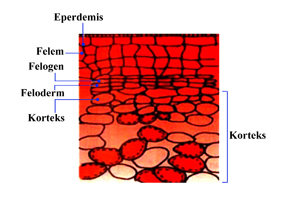
Cork tissue function is to protect the other networks in order not to lose a lot of water, given the cork cells that are waterproof. Atdikotil, cork tissue is formed by the cork cambium or felogen, the formation of cork tissue to the inside of living cells calledfeloderm, to the outside of dead cells called felem.
PLANT ORGAN
Plant organs are important there are 3 seeds, namely: roots, stems, leaves.
The third was another part of the organ is modified, eg,modification of the root tubers, flowers modification of twigs andleaves.
Root
Root is the root origin of the institution (radix), the dikotil, the roots of the institution continues to grow so as to form the root of riding, in monocots, the root of dead body, then the base of the stem will grow roots that have similar size to form hairy roots.
Dikotil monocot root and root tip is protected by a hood or kaliptra, whose function is to protect the root tip when penetrating the soil, there kaliptra cells containing beads of Amylum, called kolumela.
A. The root function
a. To anchor the plant body on the ground
b. Can serve to store food reserves
c. Dam water absorbs mineral salts dissolved
2. The root anatomy
When performed on young root cross sections will be visible from outside to inside.
a. Epidermis
b. Cortex
c. Endodermis
d. Cylinder center / Stele
a. Epidermis
Arrangement of meetings and the cells one layer thick cell, the cell walls easily bypassed water. Root hairs is a modification of the root epidermal cells, serving to absorb water and dissolved mineral salts, root hairs extend the root surface.
b. Cortex
It is located directly below the epidermis, the cells are not arranged a meeting so many have spaces between cells. Largely constructed by the parenchymal tissue.
c. Endodermis
An insulating layer between the cortex with a central cylinder.Endodermis cells can undergo a thickening agent and form a cork on the walls like the points, called point Caspary. In the subsequent growth of a thickening agent in the cell walls of cork to the center facing cylinder, when observed under a microscope it will look like hutuf U, called U cells, so that water can not go to the central cylinder. But not all cells of endodermis thickened, thus allowing water to enter the cylinder center. Cells is called the successor to the cell / cell impregnation.
d.Silinder Center / Stele
Central cylinder / stele is the deepest part of the root.
Consists of a wide range of network:
- Persikel / Perikambium
Is the outermost layer of the stele. Branch roots formed from the growth persikel outwards.
- File Transport Tubes / Vasis
Xylem and phloem consists of alternately arranged in the direction of the toes. At dikotil between xylem and phloem in there cambium tissue.
- Pith
Located at the inside or on the beam transport vessel consists of parenchymal tissue....


STEM
There is a difference between the stem and monocots dikotil theanatomic arrangement.
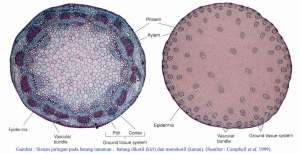
Trunk Network
A. Trunk dikotil
In the trunk there dikotil layers from outside to inside:
a. Epidermis
Consists of a compact cell membranes, did not have the space between cells. Function of the epidermis to protect the underlying tissues. In the secondary growth stems, the epidermis is replaced by a cork layer formed of the cork cambium.
b. Cortex
Stem cortex is also called the first shell, consisting of several layers of cells, which is close to the epidermal layer is composed of a network kolenkim, getting into a tissue composed of parenchyma.
c. Endodermis
Endodermis also called skin in the trunk, composed of a layer of cells, an insulating layer between the cortex to the stele.Endodermis Anguiospermae starchy plants, but absent in plants Gymnosperms endodermis.
d. Stele / Cylinder Center
Is the innermost layer of the stem. Outermost layers of the stele is called perisikel or perikambium. lkatan vessels in the stele called the type of collateral, which means xylem and phloem. The location of each side by side, next to the xylem and phloem outside.
Between xylem and phloem cambium intravasikuler there, on the subsequent development of parenchymal tissue contained in the beam transport vessels are also turned into cambium, called the cambium intervasikuler. Both can hold a secondary growth resulting in increasing the amount of trunk diameter.
In plants dikotil, hardwood and his chronic, secondary thickening growth is not continuous, but only when water and nutrients are sufficient, while in the dry season so that growth does not occur in the trunk appears thickened growth layers, each layer showingactivity for a year of growth, the layers of the circle is called the circle.
2. Monocot stem
In the monocot stem, the epidermis consists of a single layer of cells, the boundary between the cortex and stele are generally not clear. On the stele are monocots bond spreads vessels and closed collateral type
means between the xylem and phloem in not found cambium. The absence of cambium in the stems monocot monocots cause can not grow bigger, in other words do not occur secondary thickening growth. However, there are monocots that can hold a secondary thickening growth, for example on Hanjuang tree (Cordyline sp) and Pineapple tree opposite (Agave sp)
LEAF

Leaf is a modification of the stem, is part of a plant that contains chlorophyll that most photosynthetic activity takes place in most ofthe leaves.
Leaf anatomy can be divided into 3 sections:
A. epidermis
The epidermis is the outermost layer of leaves, there are upperepidermis and lower epidermis, to prevent evaporation that is toolarge, the epidermal layer is coated by a layer of cuticle. In theepidermis terdapatstoma / leaf mouth, stoma is useful for the venue for the exchange of gases into and out of a plant.
2. Parenchyma / mesophyll
Leaf parenchyma cells consist of two layers, namely the palisade(fence network) and sponges (sponge tissue), both containchloroplasts. Rail network cells are tightly sponge tissue cellsrather tenuous, so there are spaces between cells. More activephotosynthetic activity on the fence because kloroplastnyanetwork more than the sponge tissue.


0 komentar